I am looking for the grown-up in the room
Growing up, there was an unwritten rule in many households: “We don’t talk about politics.” It was a polite social boundary, often rooted in the cynical but shared childhood memory that “all politicians are corrupt.” In those days, corruption was seen as an occupational hazard of the office itself, regardless of which side of the aisle a person sat on.
Fast forward to 2026, and that sentiment has undergone a surgical adjustment. It’s no longer “politicians are corrupt”; it’s “your party is corrupt.” If you’re on the Right, the Left is the enemy. If you’re on the Left, the Right is the threat. We’ve traded a healthy skepticism of power for a fierce, almost religious devotion to our respective “political parties.”
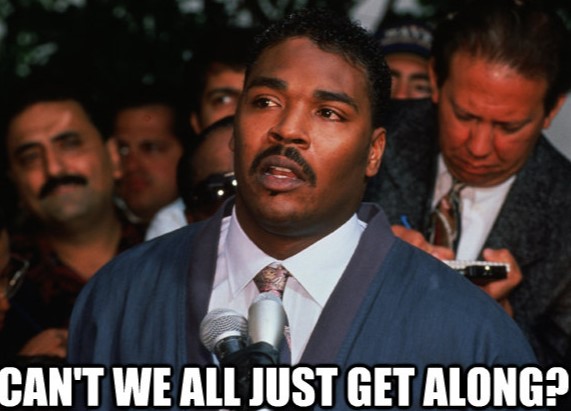
This attack of others based on emotions primarily reminds me of the Los Angeles riots in 1991. Rodney King was viciously attacked by police, resulting in huge, chaotic riots. Rodney King famously said, “Can’t we get along?” Until recently, I thought he made this comment while being intoxicated because of comedians imitating him. When he said these words, among others, he was emotional. This is where emotions belong only after logical facts are embraced.
The View from the Peacemaker’s Desk
As someone who navigates the world through the lens of a Peacemaker (Enneagram Nine) and an Architect (INTJ), this shift is more than just frustrating—it’s exhausting. On the surface, these two identities might seem at odds. The Nine seeks harmony and the “blessed” path of the peacemaker, while the Architect is driven by logic, systems, and a relentless need to deconstruct how things work.
However, they connect in a unique way: The Architect identifies the structural inconsistencies in an argument, while the Peacemaker understands why the people behind those arguments are hurting.
This combination allows me to see both sides of a debate faster than most, which is a blessing in my work as a spiritual care practitioner but a source of immense stress in our modern political climate. I find myself constantly asking: Can the grown-ups in the room finally have a real discussion?
The “Golden Reason” and the Polarization Trap
Recent data from Pew Research (2026) highlights just how deep this goes. Currently, 60% of U.S. adults believe abortion should be legal in all or most cases, yet the partisan gap is a chasm: 84% of Democrats support legality compared to only 36% of Republicans. These aren’t just policy differences; they’ve become what I call “Golden Reasons”—the moral teddy bears people hold onto to justify their side at any cost.
- The Republican “Golden Reason”: Often centers on the abortion issue. The language used—”baby killers”—is designed to evoke a visceral image of slaughter. It’s a powerful, poignant stance rooted in the New Testament’s “Thou shalt not kill.”
- The Democratic “Golden Reason”: Often involves labeling the opposition as “racist, misogynist, or environmentally destructive.” This language is equally sharp, framing the “other side” as a literal threat to the survival of the next generation.
Unpacking the Inconsistencies
When we dare to unpack these issues, the inconsistencies start to bleed through the partisan paint. For many in the Evangelical community, the “pro-life” stance is deeply held, yet it often struggles to account for the complexities of the woman carrying the child or the systemic support needed after the birth. Conversely, the “social justice” labels used by the Left often flatten millions of individuals into a single, negative caricature, ignoring the nuance of local communities and personal values.
The issue I have with this—and the stress it causes me as a Peacemaker—is that when we use “Golden Reasons” to demonize the other side, we stop looking for solutions. We stop being “architects” of a better society and start becoming wardens of our own echo chambers.
If we want to move forward, we have to be willing to look at the “inconvenient” facts on our own side of the fence. Peace isn’t found in the absence of conflict; it’s found in the courage to have a conversation that doesn’t end in a label.
Do you have the courage to speak out from a balanced perspective ? Can we agree that we are actually more alike than different?